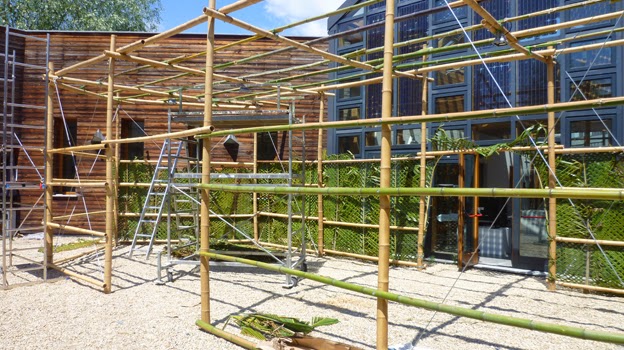
29 may 2014 - Big work today at PAV :
The first layer of plaited leaves is fixed on the structure
Camille continues to plait more leaves
Leaves are placed on the roof
The first pictures at night !
Vegetation as a political agent is a concept developped by Philippe Zourgane in his book to be published The politics of vegetation and is the central approach of architectural firm RozO architectes, co-directed by Philippe Zourgane and Séverine Roussel. This concept enables to bring to the foreground the ways in which vegetation orders social and economic relations. Vegetation is a tool for the planification and the management of the territory or on the contrary a tool for resistance.
2014-06-02
2014-05-29
RozO at PAV
Archive
2
Blending
in with the vegetation - Vegetation
is an anticolonial weapon.
The
archive images presented here are from the film Chiến
thắng Tây Bắc'
(The victory of the North West) shot in 1952 by the military forces
in Viet Minh during the war against French occupation. Here
vegetation is a tool employed in the struggle by the weakest against
the strongest. We do not refer here to the art of camouflage, nor to
a return to a primitive state: rather it is used as a subordinate
weapon for the preservation of autonomy. Vegetation is often used as
a political agent in asymmetrical or revolutionary wars, as theorised
by Mao Tse-Toung and Ho Chi Minh. These images also demonstrate a
form of counter-planning of the land that allows topography (plains
and mountains), geography and the ecosystem (the forest or the
savana) to be used as a weapon. These images depict the strength of
the soldiers who become one with their territory. I am the territory.
They inhabit it, and reconstruct it as something else. Thousands of
soldiers travel across the country without using the established
infrastructure. Instead they use pathways that allow them to avoid
detection by the French occupiers. In this way they invent a new map.
This map subverts the relationship between city and countryside, and
the new territory is built from nature (the countryside) towards
culture (the city). Where, previously, bamboo rafts were used to
cross rivers, here Giap built invisible bridges, along the Ho Chi
Minh route, made from bamboo and positioned 10 centimetres under the
surface of the water to allow them to escape the enemy's bombardment
of the infrastructure. As well as the refinement of these particular
inventions, what stands out is the use of vegetation to support the
resistance effort.
Archive
3
The
deconstruction of the indigenous landscape
–
Vegetation
as a colonial weapon
These
archive photos were taken by the French Army. They were taken between
1956 and 1958. They document harvesting in Algeria. In this case, it
is the French Army that are doing the harvesting, protected by elite
soldiers and armored units of the French army on behalf of leading
colonisers. These images clearly depict the yield obtained from the
land, and the exploitation of agriculture for the benefit of the
coloniser. But these images also show the critical aspects of the
transformation of the landscape. On the one hand, we note the radical
planning of this territory in terms of the intense cultivation of
cereals. The intensive monoculture is designed to produce the maximum
possible yield. On the other hand, a process of transformation of the
territory is under way. Aside from the word "Algeria"
written on the grain sacks, it seems that we are witnessing a French
cereal farming region. Here vegetation is clearly used to
assimilate and acculturate. Vegetation is employed by the attacker
and coloniser of a country or region, to deterritorialize its
inhabitants. Rendering the natives foreigners in their own land was a
technique that frequently used by colonisers. In the 20th
Century, following the invasion of Poland, Nazi Germany implemented a
wide-reaching process of “Germanisation” of the territory, to
render it German.
2014-05-27
At the exhibition Vegetation as a political agent curated by Marco Scotini at the Parco d'Arte Vivente ( PAV), RozO is presenting a triptyque called "When vegetation is not decoration".
This project is speaking about the vegetation used as a political agent in the control of territories in the colonial and South post-colonial world. Vegetation is not only decorative at the scale of private gardens, it becomes a tool of planification and of management of the territory or on the contrary a tool for resistance.
In that case, it offers a possibility to escape from the colonial grid to disappear. Vegetation as also been used to create the conditions to live different and autonomous lives apart from state autorities as James Scott describes it in his book "The Art of not Being Governed" or as Philippe Zourgane describes it in his text "Architectural Free Zone". This installation at PAV is presenting in this tryptique three uses of vegetation in Reunion Island, in Algeria and in Vietnam during the XXeme century. This work is realized only with archives. Vegetation can be a tool to conquer new territories but also a precious help for the resistance struggles or simply allow to enjoy life out of any control.
Archive
1
The Green room (Sal Vèrt) - Vegetation is an anticapitalist tool
The green room that will be built in the installation is an archive. It is the reconstruction of a temporary kind of space that was used to be built in Reunion Island by the popular classes since the abolition of slavery up to the XXth century. The green rooms were built for the celebration of important moments of family life as weedings, baptism, birthdays or kabars (parties). They were often built on squatted plots in the neighborhood or in one's own garden. The green room has a bamboo structure that is covered with braided coco leaves. The bamboos for the structure were cut in the countryside and the coco leaves for the cover were cut in the family, friends gardens, along the roads, along the streets or in public gardens. Once the celebration over, it is common that the bamboo canes are stocked for futur reuse and that braided coco leaves are used again for another use : protect young plants from the sun. Very often also, those green rooms are abandoned , the vegetatl elements dry in the sun and decay with the seasons.
Vegetation is used here as an anticapitalist tool to enjoy life. This architecture is free, it is built with free materials, it offers a free use on a free piece of land. It is built in a collaborative way with the family, friends, neighboors...
Tomorrow Archive 2 ...
At the exhibition Vegetation as a political agent curated by Marco Scotini at the Parco d'Arte Vivente ( PAV), RozO is presenting a triptyque called "When vegetation is not decoration".
This project is speaking about the vegetation used as a political agent in the control of territories in the colonial and South post-colonial world. Vegetation is not only decorative at the scale of private gardens, it becomes a tool of planification and of management of the territory or on the contrary a tool for resistance.
In that case, it offers a possibility to escape from the colonial grid to disappear. Vegetation as also been used to create the conditions to live different and autonomous lives apart from state autorities as James Scott describes it in his book "The Art of not Being Governed" or as Philippe Zourgane describes it in his text "Architectural Free Zone". This installation at PAV is presenting in this tryptique three uses of vegetation in Reunion Island, in Algeria and in Vietnam during the XXeme century. This work is realized only with archives. Vegetation can be a tool to conquer new territories but also a precious help for the resistance struggles or simply allow to enjoy life out of any control.
Archive
1
The Green room (Sal Vèrt) - Vegetation is an anticapitalist tool
The green room that will be built in the installation is an archive. It is the reconstruction of a temporary kind of space that was used to be built in Reunion Island by the popular classes since the abolition of slavery up to the XXth century. The green rooms were built for the celebration of important moments of family life as weedings, baptism, birthdays or kabars (parties). They were often built on squatted plots in the neighborhood or in one's own garden. The green room has a bamboo structure that is covered with braided coco leaves. The bamboos for the structure were cut in the countryside and the coco leaves for the cover were cut in the family, friends gardens, along the roads, along the streets or in public gardens. Once the celebration over, it is common that the bamboo canes are stocked for futur reuse and that braided coco leaves are used again for another use : protect young plants from the sun. Very often also, those green rooms are abandoned , the vegetatl elements dry in the sun and decay with the seasons.
Vegetation is used here as an anticapitalist tool to enjoy life. This architecture is free, it is built with free materials, it offers a free use on a free piece of land. It is built in a collaborative way with the family, friends, neighboors...
Tomorrow Archive 2 ...
2014-05-24
Philippe Zourgane was part of the seminar and workshop "Geography Law and Border" that took place at the "Altonaer Stiftung für philosophische Grundlagenforschung" Foundation from the 16th to the 18th of may 2014 in Hamburg, Germany.
Here is the presentation of the workshop :
"We want to explore particular aspects of spatial power in legal and geographically oriented research and thinking. The workshop would be something of a continuation of earlier ASFPG workshops on "Law, Colonialism and Violence" but with a focus on the overlapping terrain of spatial power and legal order. It will bring together people working with interdisciplinary approaches to legal theory, politics, and social and cultural geography. One aim would be a discussion about the lack of connection between geographically-oriented thinking and legally-oriented thinking regarding what could turn out to be the same questions.
Particular topics: sovereignty, territory and jurisdiction as geolegal forms; aspects of spatial power; mobility and borders: labour and migration; colonial spaces; national and geopolitical orders; practices and technologies of violence; territorial integrity and geopolitical legality; policing the city (sea, sky, any- thing)."
Read Philippe Zourgane's abstract.
Find all the abstracts on the following link :
http://www.asfpg.de/english/17303/Workshops/WSVal/WSValmai14/Abstracts/valmai14abs.html
Here is the presentation of the workshop :
"We want to explore particular aspects of spatial power in legal and geographically oriented research and thinking. The workshop would be something of a continuation of earlier ASFPG workshops on "Law, Colonialism and Violence" but with a focus on the overlapping terrain of spatial power and legal order. It will bring together people working with interdisciplinary approaches to legal theory, politics, and social and cultural geography. One aim would be a discussion about the lack of connection between geographically-oriented thinking and legally-oriented thinking regarding what could turn out to be the same questions.
Particular topics: sovereignty, territory and jurisdiction as geolegal forms; aspects of spatial power; mobility and borders: labour and migration; colonial spaces; national and geopolitical orders; practices and technologies of violence; territorial integrity and geopolitical legality; policing the city (sea, sky, any- thing)."
Read Philippe Zourgane's abstract.
Find all the abstracts on the following link :
http://www.asfpg.de/english/17303/Workshops/WSVal/WSValmai14/Abstracts/valmai14abs.html
Subscribe to:
Posts
(
Atom
)


